Guide
Sub-Zero 700 Series: what integrated means, and how it changes the repair
A 700 Series Sub-Zero is the integrated line, the one built to disappear into the cabinetry rather than stand proud of it, and the differences that matter are not cosmetic. The machine breathes through a vent the cabinetmaker was supposed to leave clear rather than through an obvious grille. A combination cabinet runs two entirely separate sealed systems with no air crossing between the compartments. And the doors carry custom fronts heavy enough to pull themselves out of square over a decade of use. Diagnose one the way you would diagnose a freestanding refrigerator and you will change the wrong part.
Telling a 700 from a 600 without reading anything
Stand back from the kitchen and look at the top of the appliance. A 600 Series built-in announces itself: the doors sit proud of the cabinet run, and there is a wide stainless grille above them because the machine compartment lives at the top of the cabinet. A 700 Series is meant to be invisible. Its door faces line up flush with the cabinet doors either side, the panel usually runs the full height of the opening, and from the room there may be no grille anywhere you can see. The plate settles it, and the letters on a Sub-Zero model number are readable once somebody explains the convention.
- T or B tells you where the machine compartment sits: T for a top compressor, B for a bottom one venting low at the toe kick
- R, F or C tells you the cabinet: an all-refrigerator, an all-freezer, or a combination carrying both compartments
- An I on the end means the unit left the factory with an ice maker, so there is a water line and an inlet valve in the picture
- Doors flush with the cabinet fronts and no visible grille above them: integrated, whatever the digits say
- Doors standing proud of the run with a wide grille above them: that is the 600 family, and the condenser is behind that upper grille
The airflow path is the whole difference
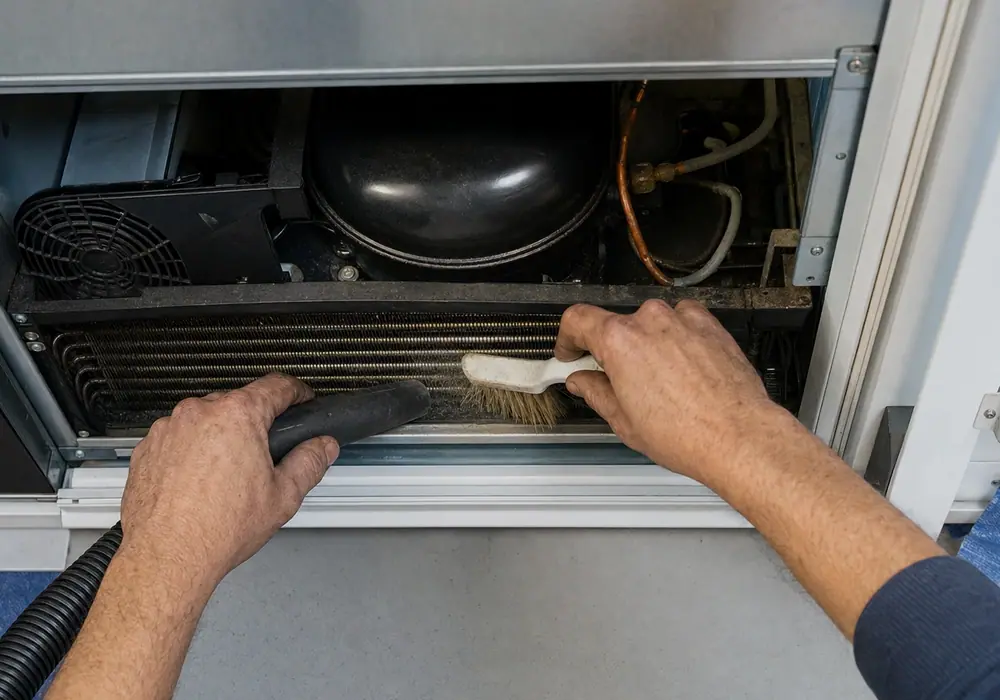
Every refrigerator has to put the heat it removes somewhere, and on a built-in that happens at the condenser inside the machine compartment. On a 600 the air goes in and out through the grille above the doors, where you can see it and where a brush reaches it. On a 700 that same air travels a route the cabinetmaker built: out through a toe-kick vent on bottom-compressor models, or up behind a decorative panel and out above the cabinet on top-compressor ones. When the route is right the unit is quiet and unremarkable. When a remodel closes it, the machine re-breathes its own hot air and runs continuously without ever reaching setpoint. Nothing has failed at that point, and no part will fix it.
- Toe-kick vents blocked by a decorative kick panel fitted flush after the appliance went in
- Top vents closed off by molding, a bulkhead, or a cabinet added above the unit in a later remodel
- Openings cut tight enough that no gap is left at the sides or the back for return air
- A unit that runs constantly, blows warm at the vent, and shows nothing wrong at any single component
- A coil that is restricted by salt-bound dust and starved of air at the same time, which is the coastal version of the same complaint
Two sealed systems, and the diagnosis they hand you for free
Sub-Zero's dual refrigeration means exactly what it says: a combination 700 runs one sealed system for the fresh-food compartment and a second, fully independent one for the freezer. No air passes between the two compartments in either direction. That is why food does not dry out and why the ice does not taste of last night's dinner, and it is also the most useful diagnostic fact anyone owning one of these can hold. If the freezer is still hard at zero while the refrigerator has climbed into the high forties, the freezer's compressor, its evaporator and the airflow through the machine compartment are proved good where they stand, and the fault has to sit on the refrigerator circuit, which carries a compressor of its own because there are two in the cabinet. Integrated columns take the same logic further. An all-refrigerator standing beside an all-freezer is two complete machines in two cabinets that happen to share a wall.
- Freezer cold and refrigerator warm: that circuit's evaporator fan, then its defrost, then its thermistor, in that order
- Both compartments drifting together on a combination cabinet: heat rejection, so the condenser and its fan come first
- One column warm and the column beside it perfect: they share a wall and a breaker and nothing else
- There is no damper and no shared duct between the compartments, so there is nothing between them to adjust or unblock
Panels, hinges and the weight nobody budgets for
Flush installation is a tolerance job. The door face has to land in the same plane as the cabinet doors either side, which leaves a hairline reveal and very little room to be wrong. Onto that door goes a custom front, often hardwood, sometimes steel, occasionally both, weighing a serious fraction of what the door itself weighs. The hinges and closers are built for it, but they are built for it when the panel is hung true in a square opening. Ten years of pulling a heavy front open by a full-length handle and the door settles a fraction low on the latch side. The gasket then touches along the top and stands slightly off at the bottom corner. What the owner sees is frost in one corner of a freezer, or a refrigerator running two degrees warm with no other symptom. The repair there is alignment, not a component.
- Gasket contact tested along the whole perimeter with a strip of paper, not just where the problem looks obvious
- Hinge and closer set so the door pulls itself the last quarter inch shut without help
- Panel fixings checked before anything is condemned, because a front that has shifted takes the door with it
- Flush doors that have started to rub the cabinet beside them, which is the same fault seen from the room
What actually breaks on these, and which of it is expensive
The failure list on the 700 family is ordinary and mostly cheap. Evaporator fan motors stop or turn noisy. Defrost heaters open. Thermistors drift a few degrees and take an obedient control board with them. Condenser fan bearings dry out, hum for a season and then seize. Gaskets soften and lose magnetic pull. Ice maker modules and water inlet valves reach the end of an unremarkable life. All of that is a part and an afternoon. The expensive words are the sealed system, meaning a compressor, a leak or a restriction, and the control boards, which is where age begins to matter. The last 700 Series cabinets came off the line in 2015 and the earliest date to 1994, so a board for a production run that closed years ago is a sourcing question rather than a shelf item.
- Cheap and common: evaporator fan, condenser fan, defrost heater, thermistor, door gasket, hinge adjustment
- Mid-range: ice maker module, water inlet valve, drain heater, hinge and closer hardware
- Expensive: sealed-system work, and any control board that has become hard to source for that production run
- Worth weighing first: replacing an integrated unit drags cabinetry work along with it, because the opening was cut to the appliance
What a technician needs from the kitchen
Integrated units are worked on in place. Dragging one out of a flush opening is how floors get scratched and heavy panels get twisted, and everything that matters is reachable from the front once the correct cover is off. What genuinely helps is knowing the front in advance: whether the panel is wood or steel, whether there is a toe kick that comes away, whether a cabinet was built above the unit after installation, and whether the water shutoff is somewhere a person can actually reach. On a top-compressor model the machine compartment is above head height, which changes what gets carried in from the van. And if the kitchen has been remodeled since the appliance went in, say so on the phone. That one sentence moves the airflow path to the top of the list, and on integrated refrigeration it belongs there more often than any component does.
Questions
Frequently asked questions
Is a 700 Series still worth repairing at this age?
Usually yes. Most of what fails on these is an evaporator fan, a defrost heater, a thermistor, a gasket or an ice maker module. What tips the arithmetic the other way is a sealed-system failure alongside a board that has become hard to source. Against that, replacing an integrated unit is a cabinetry project, because the opening was cut to the appliance.
Can I swap an integrated column for a current Sub-Zero without touching the cabinets?
Sometimes, but never assume it. The integrated format survived into the current lineup, so widths and heights are often close, and close is not identical when the reveal is a fraction of an inch. Measure the opening height, width and depth, check what the new unit needs for its vent path, and remember the existing panel, hinges and handle were made for the old door.
My refrigerator column is warm but the freezer column next to it is fine. Is the compressor going?
Not on that evidence. Those are two separate machines standing side by side, each with its own compressor, condenser, evaporator and controls, and there is no shared part beyond the wall between them. The healthy column tells you nothing about the sick one. The fault sits inside the warm cabinet: its evaporator fan, its defrost circuit, its thermistor, or airflow at its own condenser.
Appliance down in Cardiff-by-the-Sea?
Tell us the brand and what it is doing — we can usually name the likely repair before we arrive.