Guide
Start Relay Symptoms in a Sub-Zero Refrigerator
The symptoms of a failing fridge start relay are easy to recognize once you know them: a sharp click from the machine compartment every few minutes, sometimes with a short hum just before it, and a compressor that never settles into its steady run. Meanwhile the interior light still comes on and the fans may keep blowing, yet the shelves drift warmer through the day and the freezer softens. That pattern means the motor is being told to start and keeps giving up. On an older single-speed compressor the relay or its overload partner is a common cause, while on a Sub-Zero with a variable-speed compressor there is no plug-on relay at all, so the same warm-box complaint points toward the control electronics or the compressor itself.
What a start relay does inside the machine compartment
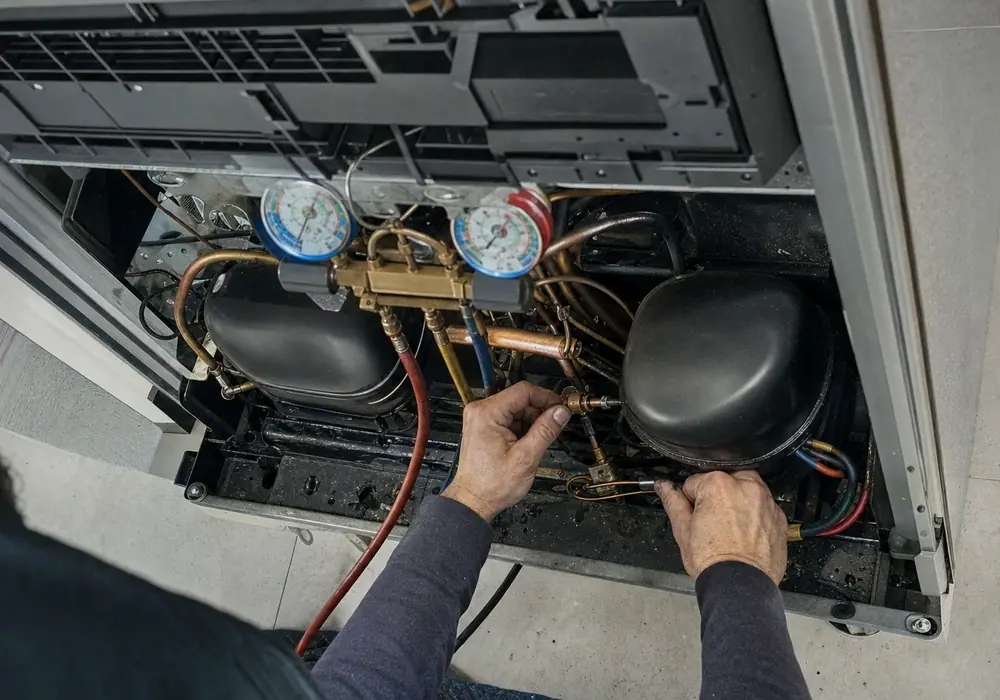
A single-speed refrigerator compressor has two motor windings, one that keeps it running and a second that only helps it get turning. The start relay is the small plastic block pressed onto the pins on the side of the compressor dome, and its job is to feed that helper winding for a second or two and then cut it out. Many relays do this with a ceramic disc that heats up and chokes the current off on its own. Clipped beside it sits an overload protector, a thermal switch that opens when the motor draws too much current or runs too hot. The two parts work as a pair, so when one fails the other usually gets blamed, tested or replaced along with it.
How a relay wears out near the coast
Every start is a small jolt of heat, and a refrigerator may fire its compressor dozens of times a day for years. Eventually the ceramic disc cracks, or the contacts inside pit and stick, and the helper winding either never gets power or never lets go of it. Cardiff-by-the-Sea adds its own wear: kitchens a short walk from the ocean breathe damp, salty air, and over the years that film dulls the spade terminals and connectors where the relay meets the compressor. Heat makes it worse. A condenser packed with lint and dust forces the compressor to push against higher pressure, so each start pulls harder on a relay that is already tired.
The symptoms owners actually notice
Relay trouble rarely arrives all at once. It tends to begin as an occasional missed start and grows into a refrigerator that cannot hold temperature at all, whether the house is in the Composer District or up in Poinsettia Heights. Watch and listen for these signs:
- a dry click from the compressor area every few minutes, with or without a brief hum, and no steady running sound afterward
- lights, display and fans behaving normally while the cabinet slowly warms
- milk that feels cool rather than cold, and ice cream gone soft by evening
- a compressor dome that feels hot even though it has not run for a while
- on a Sub-Zero with separate refrigerator and freezer compressors, one side warming while the other stays cold
Relay, overload or compressor: why a meter decides
A repeating click proves the compressor is not starting; it does not prove why. A failed relay, a weak overload, low supply voltage and a compressor whose windings have opened or shorted can all produce the same sound. A technician separates them with a meter, checking resistance across the compressor pins and between each pin and the metal housing. If the windings read open or grounded, a new relay will not help and the conversation turns to the sealed system. Current Sub-Zero literature warns that its refrigerators carry flammable refrigerant and that only technicians trained for it should open that circuit, which is one more reason to confirm the diagnosis before anything is cut or brazed.
What a Sub-Zero display may report
Many Sub-Zero units watch their own compressors, so read the control before guessing. On Classic Series models, codes 60 1 60 and 60 2 60 mean the control saw no compressor load on the refrigerator or freezer side, while 60 1 38 and 60 2 38 flag lost communication with a variable-speed compressor. Seeing 95 2 01, 95 2 00, 95 1 01 or 95 1 00 tells you a control pin that switches a compressor has frozen off or on. Variable-speed compressors have no plug-on relay, so on those units relay-like symptoms usually trace to the board, the wiring or the compressor. For any of these codes, switch the breaker off for 30 seconds, restore power, and arrange service if the code comes back.
Is start relay replacement a DIY job?
On a basic freestanding fridge, a handy owner can sometimes unplug the unit, pull the old relay off the pins and press on a matching one. A built-in Sub-Zero is a different job. The compressor lives in a machine compartment above or below the food space, the unit is often fastened to the cabinetry, and reaching the relay can mean sliding a heavy appliance out of a tight opening. A relay that does not match the compressor can overheat the very motor it is meant to protect. Our view is simple: owners observe, record and reset, while testing and the part swap belong to a technician. Before you phone, find the rating plate with our note on the model and serial number.
Checks worth making before the visit
Gather a few facts and rule out the easy causes first. If the clicking carries on afterward, book Sub-Zero refrigerator repair and hand over your notes; a preventive maintenance plan helps keep the coil from becoming the problem again.
- note the set point, each compartment's real temperature and the click rhythm
- a Classic (CL) condenser sits behind the flip-up grille, a Designer (DET, DEC) one behind the kickplate held by two screws; turn power off at the control panel, wear gloves and vacuum along the fins with a soft brush
- keep the front grille free of lint and clean the coil several times a year
- a refrigerator reading above 48 degrees while set at 38 is unlikely to recover from a cleaning, so call for service
Questions
Frequently asked questions
Can I replace a refrigerator start relay myself?
On a plain freestanding fridge a careful owner sometimes can, but on a built-in Sub-Zero the swap is better left to a technician. Reaching the relay may mean easing a very heavy unit out of its opening, and a part that does not match the compressor can cook the motor. Have the fault confirmed with a meter first, since a compressor with failed windings is not rescued by a fresh relay. Cardiff-by-the-Sea Sub-Zero Repair, Cardiff-by-the-Sea: (858) 703-5919.
How can I tell a bad start relay from a bad compressor?
By ear you usually cannot, because both faults give the same click and brief hum. A technician reads resistance across the compressor terminals and from each terminal to the metal shell; normal readings send the search back to the relay or overload, while an open or grounded winding means the compressor itself is finished. Say so when you call Cardiff-by-the-Sea Sub-Zero Repair on (858) 703-5919.
Do all Sub-Zero refrigerators use a start relay?
No, models with variable-speed compressors are brought up to speed by electronic controls rather than a plug-on relay. On those units a silent compressor and a warming cabinet usually lead to the control board, its wiring or the compressor, and a Classic Series display may show a code such as 60 1 38 that is worth reporting when you book. Cardiff-by-the-Sea Sub-Zero Repair answers that on (858) 703-5919.
Appliance down in Cardiff-by-the-Sea?
Tell us the brand and what it is doing — we can usually name the likely repair before we arrive.